Mass Restaurant Closures Nearly Doubled Last Year — Here's How to Keep Yours Open

The country's biggest chains closed locations at nearly twice the rate they did two years earlier. The forces behind it — expensive debt, relentless cost inflation, and a more cautious customer — don't stop at the chains. Here's what actually happened, and what it takes to run lean enough to outlast it.
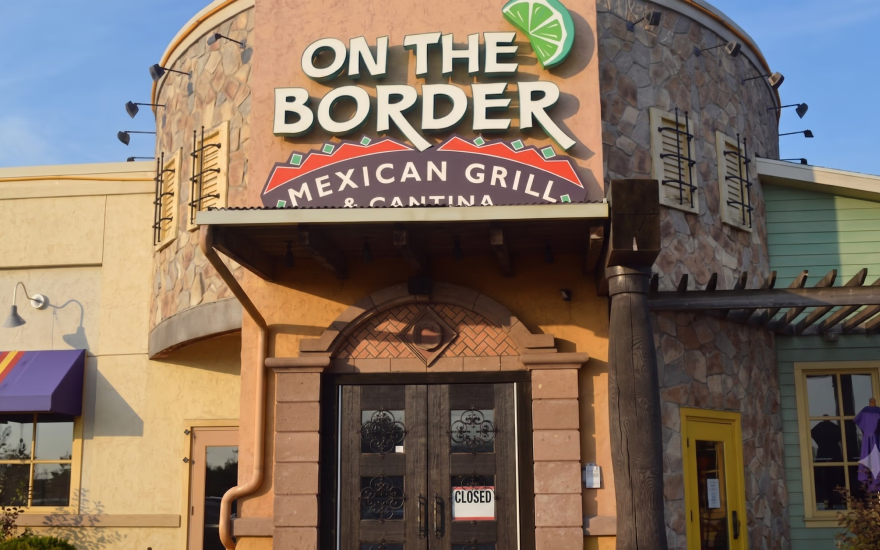
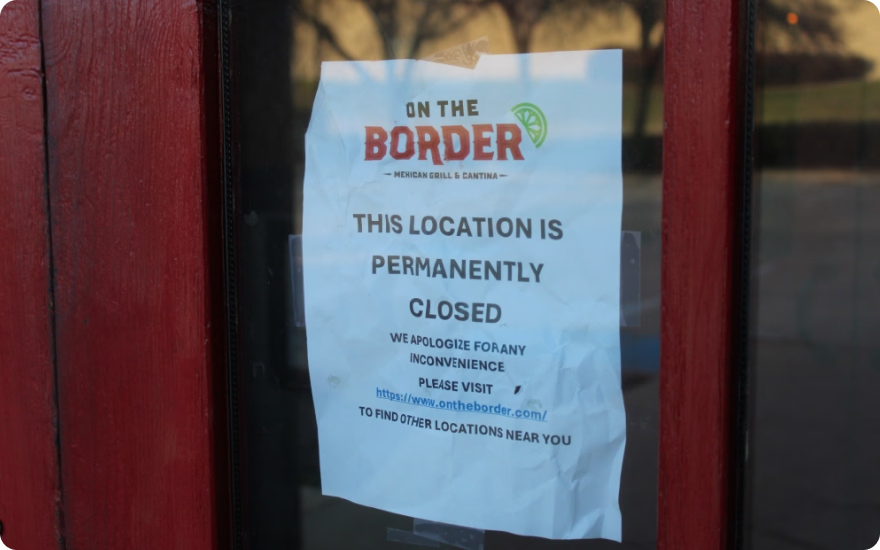
Late last year, On the Border went dark. The Tex-Mex chain had been feeding people fajitas and frozen margaritas for four decades, across two dozen states. Then it filed for bankruptcy, and one by one, its company-owned dining rooms locked their doors for good. It wasn't a slow fade. It was a chain that had looked fine from the parking lot right up until it wasn't.
On the Border wasn't alone, and that's the part worth paying attention to. According to Technomic data reported by Nation's Restaurant News, 33 of the country's Top 500 restaurant chains closed 10% or more of their locations in 2025 — nearly double the 17 that did so in 2023. Roughly half of the 500 largest chains either shrank or failed to add a single new unit. TGI Fridays shuttered around 134 restaurants. Red Lobster closed roughly 131. These are not corner cafes with one bad landlord. These are national brands with real balance sheets, and they still couldn't keep their doors open.
Here's what the data says, and what it means for the operators who don't have a private-equity backstop when the math stops working.
The Numbers Behind the Wave
The 33-chain figure sounds like a pandemic story, but it isn't — not really. Back in 2020, 75 Top 500 chains went through mass closures, an obvious outlier. Strip that year out and the picture is more sobering: 2025 looks a lot like 2019, when 35 chains closed 10% or more of their units. In other words, this isn't a one-time shock working its way through the system. It's the industry sliding back toward its pre-pandemic baseline of attrition — and doing it on the upswing.
The two years right after 2020 were quieter than they should have been. Government relief — the Paycheck Protection Program, Economic Injury Disaster Loans — kept a lot of restaurants breathing that otherwise wouldn't have. In 2021, 27 top chains went through mass closures; in 2022, that number dropped to 21. Then the relief ran out. Cash ran out behind it. By 2024, mass closures were back up to 27, and last year they jumped again.
The safety net is gone, and the bills that were deferred are now due.
What's Actually Driving It
Three pressures are doing most of the damage, and they compound each other.
The first is debt — specifically, expensive debt. A lot of chains borrowed heavily to survive 2020 and 2021. That debt didn't disappear; it got more costly to carry as interest rates climbed. A restaurant company servicing a big loan at yesterday's rates has far less room to absorb a bad quarter than one that stayed lean. When sales soften, the debt payment doesn't soften with them.
The second is cost inflation that simply hasn't let up. Food and labor — the two biggest lines on any restaurant's P&L — have each climbed by roughly a third over the past five years, according to industry reporting from Restaurant Dive, which found that the overwhelming majority of operators faced higher food and labor costs in a single recent year. Menu prices can only chase those costs so far before the customer notices.
Which is the third pressure: the customer is noticing. Diners have been trading down to cheaper options or skipping the visit entirely, and a growing share of the occasions that remain are takeout rather than dine-in. Full-service restaurants — the big dining rooms with the most seats to fill and the most staff to schedule — have been squeezed hardest. When traffic thins out in a room built for a crowd, the labor and rent don't shrink to match. The margin does.

The Cautionary Tales
The chains that fell hardest tend to share a profile: they expanded aggressively, financed that growth with debt, and left themselves no cushion when costs rose and traffic fell. Their stories are worth reading closely, because the failure points are the same ones that show up in a single independent location — just multiplied.
Take Rubio's Coastal Grill, the fast-casual coastal-Mexican brand. In 2024, Rubio's closed 48 underperforming California restaurants — roughly a third of its footprint at the time — pointing squarely at "the increased cost of doing business" in the state after California's $20 fast-food minimum wage took effect. Rubio's had never fully rebuilt after an earlier bankruptcy, and when labor costs stepped up sharply in its home market, the locations that were already marginal couldn't carry the new number.
Then there's Roti, the fast-casual Mediterranean chain. Roti's post-pandemic recovery proved short-lived; it filed for Chapter 11 and moved to permanently close about a third of its restaurants. A concept that had once looked like a category winner spent its last healthy years shrinking instead of scaling.
Pinstripes, the multi-state "eatertainment" chain built around bowling, bocce, and a full menu, offers the starkest version. It went public in late 2023, then filed for Chapter 11 with roughly $143 million in debt and closed 10 of its 18 locations — more than half — citing inflationary pressure and consumers pulling back. No Top 500 chain retrenched by a larger percentage last year. A big, expensive format is wonderful when the room is full and brutal when it isn't.
And On the Border, where this started, is the multi-state version of the same lesson: a large, spread-out footprint, thin margins, and no room to absorb a downturn without the whole structure coming under strain.
None of these brands failed because people stopped wanting fajitas or falafel or a lane to bowl in. They failed because their cost structures had no give in them. When you're running that lean on cushion — even if you're running large — a single bad stretch doesn't cost you a location. It costs you the chain.
How to Protect Your Business
Here's the more useful truth buried in all of this: independents and regional groups are not simply smaller versions of the chains that closed. In some ways, you're better positioned. You don't carry hundreds of millions in acquisition debt. You can change a schedule this afternoon without a corporate approval chain. What you have to do is protect that agility on purpose, because the pressures — food costs, labor costs, a choosier customer — hit you too.
That protection comes down to controlling the things you actually control, and for most operators the single biggest controllable line is labor.
- Schedule to real demand, not to habit. The fastest way to bleed margin is to staff Tuesday like it's Friday. Look at what your sales data actually says about your traffic patterns — by daypart, by day of week, by season — and build the schedule to match the room you'll really have, not the one you're hoping for. Push Scheduling pulls your POS sales data straight into the schedule builder, so your labor-to-sales target is visible while you're assigning shifts, not discovered after payroll runs.
- Watch labor cost as a percentage, in real time. The chains that closed learned their numbers were off when the quarter closed. You don't have that luxury, and you shouldn't want it. Track labor as a share of sales as the week unfolds, so you can cut a slow shift or add a hand before the ratio gets away from you — not a month later when it's already baked into the P&L.
- Kill the manual busywork that hides your real costs. Time theft, buddy punching, and hand-entered hours quietly inflate labor spend and swallow manager time that should go to the floor. Integrated time tracking and payroll close those gaps and give you clean numbers to make decisions from.
- Don't confuse growth with strength. The cautionary tales all grew into their problems. Before you add a location or a format, pressure-test it against a genuinely bad month — not an average one. The operators still standing are the ones who left themselves room to be wrong.
The chains that closed last year weren't undone by a single dramatic mistake. They were undone by a structure with no slack in it, meeting a year with no mercy. The independents who make it through this stretch will be the ones who see their numbers clearly and act on them early — while there's still time for the decision to matter.
If you'd like to see how Push helps multi-location operators forecast labor, tighten scheduling to real sales, and keep payroll clean through a tougher year, book a demo — we'll walk through it with your numbers.