B.C. Minimum Wage Rises to $18.25 — Just as Restaurant Margins Hit a Breaking Point


At $18.25 an hour, British Columbia now has the highest minimum wage of any Canadian province. The raise itself is small — but for operators already running on thin margins, the ripple it sends up the pay band is the part worth planning for.
The new rate took effect June 1, and within the week you were back in the spreadsheet, nudging the cooks who were already above minimum, the shift leads who expect to stay a clear step above the line, the front-of-house staff whose tip-out math just shifted again. A wage floor doesn't move in isolation. It lifts the whole structure resting on top of it.
British Columbia's general minimum wage rose from $17.85 to $18.25 on June 1, 2026 — a 2.1% bump tied to the prior year's inflation, and now the highest of any province in the country. On its own, forty cents an hour is not the story. The story is what that forty cents does to every wage sitting above it, in a year when most B.C. operators have almost no room left to absorb it. Here's what the data says, and what the sharpest operators are doing about it.
One in Three Restaurants Is Now Breaking Even or Losing Money
For most of the last few years, "cost pressure" was a phrase. In 2026 it's the operating reality for a startling share of the industry. Restaurants Canada's spring report found that one in three operators is now breaking even or losing money — roughly triple where it sat in 2019. That's not a slow drift. That's a third of the dining rooms on your block running at or below the line.
The Squeeze Isn't Theoretical Anymore
Ask operators what's squeezing margins and two answers dominate: 91% point to food costs and 87% to labor as their top pressures. Food costs you can't legislate. Labor you can't simply cut — not when guests still expect a full patio on a Saturday and a kitchen that fires on time. So the wage floor goes up, food stays expensive, and the consumer, feeling their own squeeze, dines out a little less. That's the "perfect storm" the industry has been naming out loud.
A small raise on a healthy margin is a rounding error. A small raise on no margin is a decision.

Why a Raise at the Bottom Lifts the Whole Pay Band
The mistake is to model a minimum-wage increase as a line item that only touches minimum-wage earners. In a real restaurant, almost nobody on your line is actually at minimum wage for long.
Your experienced cooks already sit above it — and they notice when a first-week dishwasher closes the gap. Your shift leads expect to stay a recognizable step ahead of the people they're directing. Compress those differentials and you don't save money; you create flight risk, in a province where the cook shortage has been a structural problem for the better part of a decade. B.C.'s kitchens have been short on trained cooks for years, and that hasn't eased — 57% of Canadian operators say recent immigration-policy changes will reduce their ability to hire kitchen staff. Losing a seasoned line cook over a wage compression, in this market, can cost you far more than the raise that would have kept them.
So the honest cost of June 1 isn't forty cents times your minimum-wage headcount. It's forty cents rippling up a pay band you have to keep intact to hold your team together. The operators who'll come out ahead are the ones who can see that full number before it lands on payroll — not after.
What the Sharpest Operators Are Doing About It
The instinct under cost pressure is to slash hours and tighten the schedule until the labor ratio looks right. That works for exactly one pay period. Then the understaffed Friday turns tables slowly, the reviews dip, and the guest count slips a little further. Cutting blind protects the ratio but damages the business.
The better move is to get precise — to know your labor cost down to the shift before you commit to it, and to schedule against real demand instead of a gut feel. Here's where to start.

1. Model the Full Ripple Before It Hits Payroll
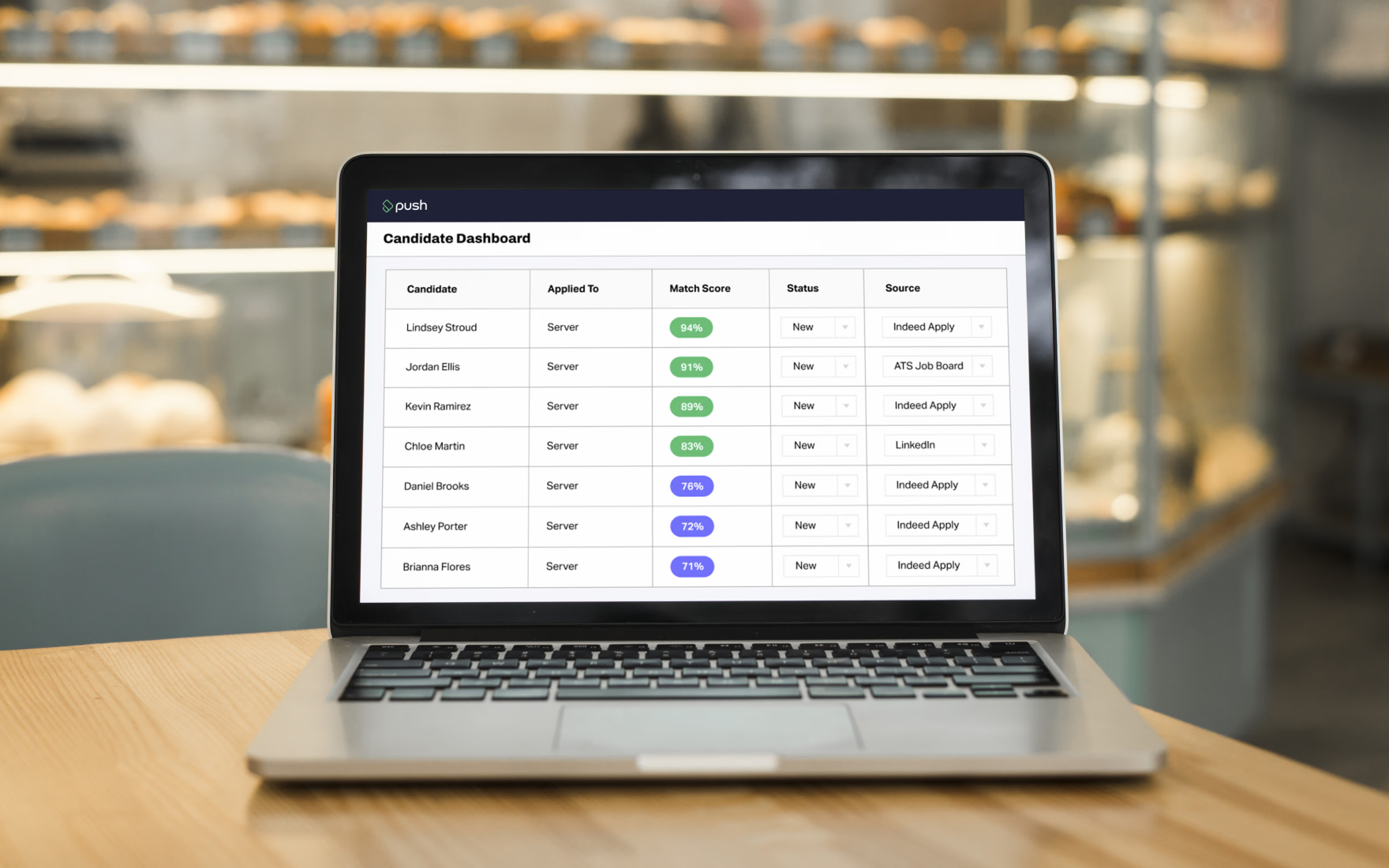
Before you rebuild a single schedule, run the actual number. Not "minimum-wage staff times forty cents," but the true cost of holding your differentials: the cooks, leads, and senior servers whose rates you'll lift to keep the band intact. Forecasting that pulls your live wage data and projected hours shows you the real labor figure for next month now, while you can still adjust prep, menu mix, or hours — instead of discovering it after the run.
2. Schedule Against Demand, Not Habit
Most schedules are copied forward from last week because that's faster. But your labor-to-sales target only holds if the bodies match the demand curve. Pulling POS sales history into the schedule builder lets you staff the actual Tuesday-night lull and the actual Saturday rush, rather than carrying the same five-person evening through both. The savings here are real and they don't cost you a single guest.
3. Stagger, Don't Slash
When you do need to trim hours, trim the edges, not the spine. Stagger start and end times in 15-minute increments so coverage tracks the rush instead of bracketing it in clean half-hour blocks. Cut the thirty quiet minutes before the doors get busy, not the person who closes.
4. Make Overtime and Compliance Visible in Real Time
Tighter scheduling means more last-minute shuffles, and every shift change is a chance to tip someone into overtime or miscalculate holiday pay without anyone noticing. Catch those mistakes at payroll and it's already too late — the cost is locked in. Real-time labor tracking that flags an approaching overtime threshold while the shift is still running gives you room to adjust before a small scheduling slip turns into a premium you never budgeted for.
5. Protect the People You Can't Afford to Lose
In a market this short on trained cooks, retention is a cost-control strategy, not an HR nicety. Published-ahead schedules, fair distribution of the good shifts, and a little self-service flexibility cost almost nothing and do more to keep a seasoned line cook than another fifty cents you can't spare. Keeping the team you have is cheaper than the wage war to replace them.
The Thread Running Through All Five
Every one of those moves depends on the same thing: seeing your labor cost clearly, early, and at the level of the individual shift. That's the real shift June 1 forces. When the wage floor was low and margins were comfortable, you could run labor on instinct and clean it up at payroll. At $18.25 on a third of the industry's margins, instinct is too expensive. The number has to be visible while you can still act on it.
This is exactly what Push Operations was built for: scheduling that pulls your live POS sales and wage data into the build, so your labor-to-sales target is in front of you while you're assigning shifts — and forecasting that shows you the true cost of a wage change before it reaches payroll, ripple and all. Not a tighter screw to turn, but a clearer picture to plan against.
B.C.'s wage floor will keep rising; it's indexed to inflation, and June 1 won't be the last increase you absorb. The operators who stay out of that one-in-three are the ones who stop reacting to the raise after the fact and start forecasting it before it lands.
The intelligence behind your restaurant starts with how precisely you can schedule it.
If you'd like to see how Push helps B.C. operators model a wage change before it hits payroll and schedule against real demand, book a demo — we'll walk through it with your own numbers.