The 5 Daily Metrics Fast-Casual and QSR Franchise Owners Can't Afford to Ignore


The franchise groups growing in 2026 aren't watching different metrics than everyone else. They're watching the same five — every day — instead of waiting for Friday's report to tell them what already went wrong.
It's Friday at 9 a.m. You're pulling Wednesday's labor report from your scheduling tool. Location B was three percentage points over budget on Tuesday night. Drive-thru times spiked in the Thursday dinner rush at Location D. Voids ran high at Location A all week.
You know all of this now. You couldn't have done anything about any of it.
That's the spot most fast-casual and QSR franchise owners are still running their business from — reading reports that arrive two or three days after the decisions that could have changed them. In a sector where labor and food each take up to a third of sales and a single overstaffed shift can wipe out the margin from two well-run ones, those two or three days are the margin.
Daily visibility isn't a nice-to-have. It's how the franchise groups still growing this year stay ahead of the ones running on monthly closes. Here are the five metrics worth watching every morning — and what each one is actually telling you when you read it right.
Why "Daily" Is the Whole Point
A weekly P&L tells you what already happened. A monthly report tells you what's been happening for a while. Neither tells you what to fix today.
The franchise groups winning right now are the ones who treat their operating dashboard the way they treat their POS — as a real-time tool, not a retrospective document. 89% of restaurant operators reported rising labor costs in 2025, and the operators absorbing those costs without passing them to guests are doing it through visibility, not by working their people harder. They can see the leak before the bucket is empty.
This is the territory Push's BI Insights was built for — and it's why franchise owners who haven't moved to a real-time intelligence layer are now operationally behind their peers. But you don't need to be a Push customer to use the framework below. You just need to know which numbers belong on a daily dashboard — and which ones you can leave to the monthly close.
1. Labor as a Percentage of Sales (Real-Time, by Location)
The single most important number on a franchise owner's daily dashboard. Every other labor metric is downstream of this one.
What it is: Total labor cost divided by total sales for a defined period, expressed as a percentage. Daily means by-the-hour or by-the-daypart, not just by-the-day.
Why daily: A labor percentage you find out about on Friday is a labor percentage you can't fix until next week. The 2025 NRA Restaurant Operations Data Abstract puts the median limited-service labor cost at 31.7% of sales in 2024 — but the gap between the median operator and the profitable operator is two to three percentage points, and that gap is almost always made up of small in-shift decisions that nobody saw in time.
What good looks like: QSR operators typically run labor between 25% and 30% of sales. Fast casual generally lands 28–32%. Profitable operators in either segment hold themselves a point or two below the median.
What to watch for: Single-location spikes during off-peak windows (over-scheduled mid-afternoon), shifts where labor outpaces sales by a daypart factor of 1.5x or more, and the slow drift up that compounds — most labor overruns aren't dramatic, they're 50 basis points a day that nobody flagged.
The sub-metric inside labor percentage that deserves its own daily view: overtime hours, by location and by employee. Overtime tends to stay invisible until payroll runs — and by then the cost is already on the P&L and the conversation with the team is harder. The franchise groups catching OT early are doing it through real-time alerts when an employee crosses 32 or 36 hours mid-week, not by reviewing the labor report on Sunday and discovering three people quietly went over. A labor percentage that looks fine for the week can still be hiding a payroll surprise on Friday. Watch the underlying hours, not just the percentage.
For multi-unit franchise owners, the real value isn't the number itself. It's the variance between locations — which store is consistently 200 basis points lower than its peers, and what they're doing that the others aren't. A dashboard that surfaces those outliers automatically is doing more for your P&L than another all-hands call.

2. Sales Per Labor Hour (SPLH)
If labor as a percentage of sales is the cost story, sales per labor hour is the productivity story.
What it is: Total sales divided by total labor hours scheduled. Tells you how much revenue each hour of labor is producing — independent of wage rates or sales volume.
Why daily: Labor percentage can look "fine" on a day where you under-scheduled and the team buried themselves in service. SPLH catches what labor % misses — whether the people on the floor were actually being used productively. Black Box Intelligence frames SPLH as a sharper read on labor performance than the percentage alone, because it isolates productivity from pricing.
What good looks like: SPLH benchmarks vary widely by concept, but for fast-casual operations a typical range sits between $80–$120 per labor hour at strong locations, with QSR averages often higher due to throughput. The most useful benchmark, though, is your own best location — not the industry median.
What to watch for: A daypart where SPLH craters without a corresponding sales drop usually means over-scheduling — too many hands for the demand. A daypart where SPLH spikes might look like a win, but if it's accompanied by speed-of-service degradation or guest complaints, you've underscheduled and burned through goodwill.
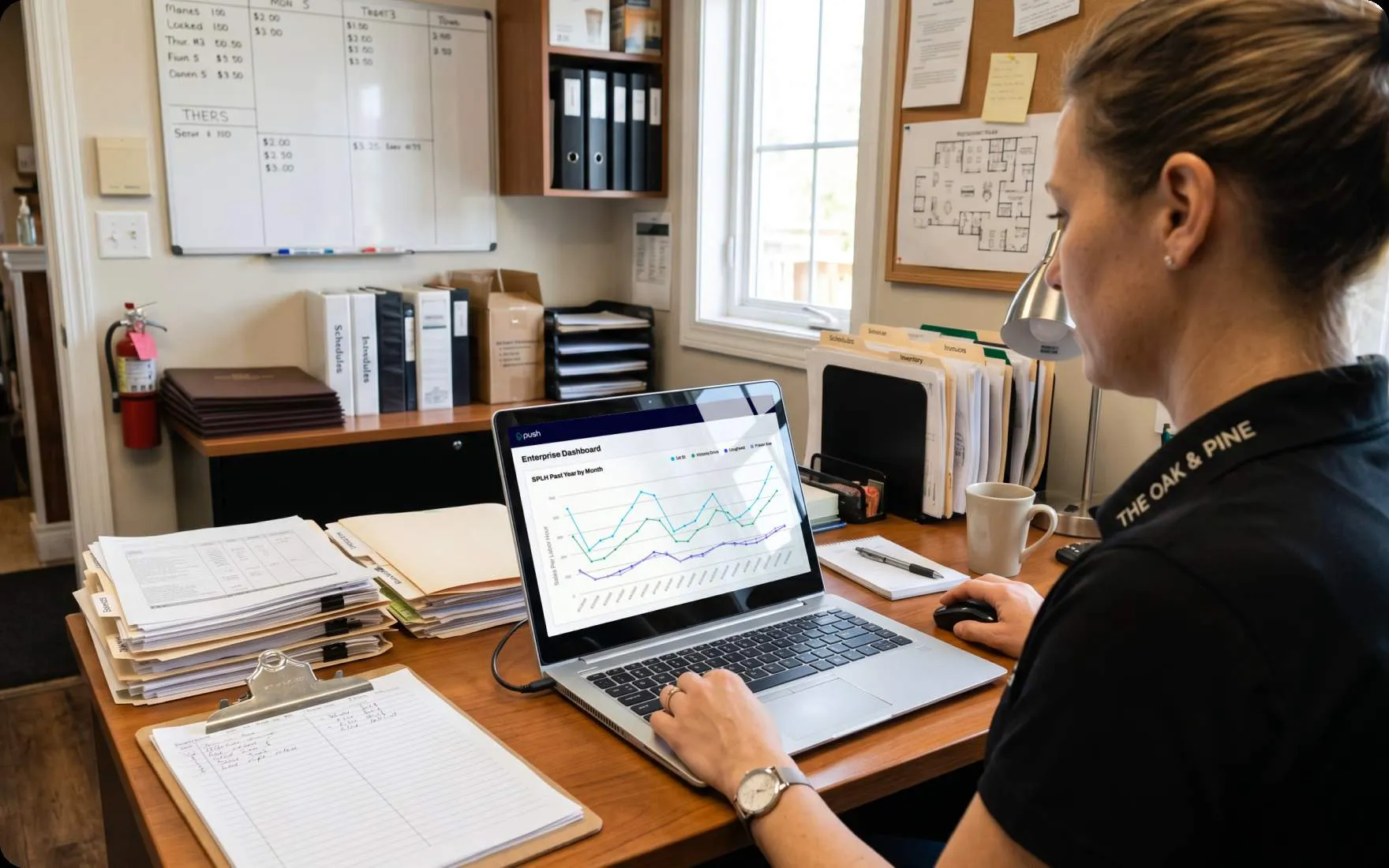
The franchise operators using SPLH well are running it on a dashboard alongside labor percentage so they can see both lenses on the same screen. Cost and productivity together tell a story that neither one tells alone.
3. Speed of Service / Order-to-Handoff Time
For QSR and fast-casual franchises, the metric most directly tied to guest experience — and the one most easily ignored until guests start choosing the place across the street — is speed of service.
What it is: The elapsed time from a guest's order being placed to the food being handed off. In drive-thru, the 2025 QSR Drive-Thru Study put the industry average total time at 335.4 seconds — roughly 5 minutes and 35 seconds. Service time (order to handoff, excluding wait) averages 4 minutes and 15 seconds; AI-enabled drive-thrus run closer to 3:53.
Why daily: Speed of service degrades quietly. Guests don't usually complain — they just don't come back. By the time the metric shows up in a guest satisfaction report, you've lost a month of repeat visits you'll never quantify.
What good looks like: Total drive-thru time under 4 minutes is competitive. Order-to-handoff under 3 minutes inside or at the window is strong. The brands leading the category — Taco Bell, Tim Hortons, Arby's per the 2025 study — consistently come in under those marks.
What to watch for: Mid-shift slowdowns that correlate with a specific staffing change (a new prep cook hits the line, an experienced cashier goes on break). Day-of-week patterns that show your Friday peak is 90 seconds slower than your Tuesday peak. Voice-AI adoption is reshaping the benchmark — Taco Bell shaved 1 minute 54 seconds off its drive-thru time with voice AI, which is now the bar competitors are being measured against.
Speed of service is also where the labor and service stories intersect. A franchise group that tracks SPLH and speed-of-service on the same dashboard can spot the moment cutting one more labor hour stops saving money and starts costing repeat visits.

4. Average Order Value (AOV)
The top-line lever most franchise owners check weekly — and that's two days too late.
What it is: Total sales divided by total transactions. Tells you how much the average guest is spending per visit.
Why daily: AOV drifts. A new promotion that's discounting bundles harder than expected, a new cashier who isn't suggesting the upsell, a menu change that pulled high-margin items off the board — any of these can pull average check down half a dollar without showing up in raw sales for a week. By then, you've lost the daypart's worth of margin you can't get back.
What good looks like: Fast-casual operations typically average $15–$25 per person, with $14 considered a healthy floor at smaller-format concepts. QSR averages run narrower — $8–$12 per check. A QSR with a $7 average ticket and a fast-casual with a $14 average ticket are both healthy if margins hold; the danger is the silent drift.
What to watch for: A consistent dayparts where AOV is 10%+ below your weekly average (often morning rush, where attach rates die without prompts). Locations where AOV is sliding while sales are flat — that's a transaction-volume story masking a check-size story. New menu items whose introduction should have raised AOV but didn't — usually a training problem, not a menu problem.
The most useful version of this metric for franchise operators is AOV by daypart, by location, with a rolling 14-day comparison. That's the view that surfaces the drift before it becomes a quarter.
5. Voids and Comp Percentage
Voids and comp percentage is the metric most franchise owners track once a month and almost never act on quickly enough — and the one that compounds the fastest when it's drifting.
What it is: Total dollar value of voided items and manager comps as a percentage of gross sales, by location and by manager.
Why daily: Voids and comps are where margin disappears without anyone noticing. They're also where loss-prevention exposure lives — both legitimate operational issues (a comped meal for a kitchen mistake) and less-legitimate ones (an item voided after the guest paid cash for it). Either way, the longer you wait to look, the harder the conversation gets.
What good looks like: Most operators target voids and comps under 1–2% of sales. Tighter franchise groups aim for under 1%. A single restaurant in one published case study cut comps and deletes by two full percentage points, recovering roughly $100,000 in annual P&L impact.
What to watch for: A specific manager whose comp rate runs 2x the rest of the team's. A specific shift (often the late-night close) where voids cluster. A daypart where voids spike on the same days the manager-on-duty is the same person. None of these are accusations — they're conversations. The point of daily visibility is that you have the conversation when it costs you a coaching moment, not when it costs you a year of margin.
Voids and comps don't deserve daily anxiety — but they deserve daily visibility. The two are not the same thing.
Five Metrics, One Dashboard
Each of these metrics is useful in isolation. Together, they're the operating picture.
The franchise groups outpacing the category in 2026 share a common setup: every one of these five numbers is on one screen, refreshed in real time, broken down by location, with thresholds set so the dashboard tells them when something needs attention rather than waiting for them to go find it.
That's the gap Push's BI Insights closes for multi-unit operators — pulling live POS data, labor data, scheduling data, and payroll data into a single customizable dashboard, so a regional manager opens their laptop on Tuesday morning and sees Monday's labor variance by location before they finish their coffee.
Crumbl Cookies — one of North America's fastest-growing dessert chains, now with more than 1,000 locations — partnered with Push in 2025 for exactly this reason. As Jason McGowan, Crumbl's CEO, put it: "Our franchise owners asked for flexible, powerful operational tools. By partnering with Push Operations, we're providing them the option to manage labor costs and process payroll in minutes rather than hours, allowing them to focus more on creating the world's best cookies."
The product matters less than the discipline. Whether you build the dashboard inside Push, inside a BI tool you already own, or inside a homegrown spreadsheet that someone updates every morning at 8 a.m., the five metrics are the same. The question is whether you're seeing them on Tuesday or finding out about them on Friday.
Frequently Asked Questions
What's a good daily labor cost percentage for a QSR franchise?
QSR operations typically run labor between 25% and 30% of sales, with profitable operators a point or two below that range. Fast-casual concepts generally land 28–32%. The most useful benchmark is your own best-performing location, not the industry median.
What is sales per labor hour (SPLH) and why does it matter?
SPLH is total sales divided by total labor hours scheduled, expressed in dollars per hour. It measures labor productivity — how much revenue each labor hour produces — independent of wage rates. Labor percentage tells you about cost; SPLH tells you whether your team was actually being used productively. Strong fast-casual operations often run $80–$120 SPLH, with QSR throughput-driven concepts running higher.
How long should drive-thru service take in a QSR?
The 2025 QSR Drive-Thru Study puts the industry average total time at 5 minutes 35 seconds and service time (order to handoff) at 4 minutes 15 seconds. Competitive operators aim for under 4 minutes total. AI-enabled drive-thrus now run closer to 3 minutes 53 seconds — and that's the new benchmark the category is being measured against.
What is a healthy average order value for fast casual?
Fast-casual concepts typically average $15–$25 per person, with $14 a reasonable floor for smaller-format concepts. QSR averages run $8–$12 per check. What matters more than the absolute number is whether your AOV is drifting — a half-dollar slide over two weeks costs more than most operators realize.
What's an acceptable void and comp percentage?
Most operators target voids and comps under 1–2% of sales. Tighter franchise groups hold the line at under 1%. The metric is less about catching theft on day one and more about creating the daily visibility that prevents small drift from becoming a quarter of unexplained margin loss.
The Bottom Line
Daily isn't a frequency. It's a posture.
The franchise groups that run on these five metrics aren't checking them out of compliance with someone else's playbook. They're checking them because they've learned, sometimes the expensive way, that the cost of finding out on Friday what happened on Tuesday is higher than the cost of looking every day. The discipline isn't the dashboard. The discipline is treating the dashboard the way the line treats the ticket rail — something you watch live, not something you review at the end of the week.
For multi-unit fast-casual and QSR operators, this is the entire game in 2026. Labor pressure isn't easing. Guests aren't slowing down. The competitor down the street isn't waiting on your monthly close. The franchise groups that come out ahead are the ones who built the muscle of looking — at all five of these numbers, every morning, at every location — before they needed to.
The intelligence behind your restaurant starts with what you measure every day.
If you'd like to see what these five metrics look like in a live dashboard built specifically for multi-unit operators, book a demo — we'll walk through your numbers, on your data, and show you what daily visibility actually changes.