How Restaurants Are Increasing Labor Margins Without Cutting Their Teams

Overstaffing isn't generosity. It's a forecasting gap with a price tag — and closing it doesn't have to cost you your team.
It's 2:40 on a Tuesday. Three servers are on the floor. Two of them are rolling silverware, the patio hasn't turned since noon, and everybody knows the next real ticket is ninety minutes away. Nobody decided to overstaff that shift. It happened because the schedule was built based on a generic template. The weather, sales forecast, and the local events (or lack thereof) were never considered.
That habit has a number attached to it. Most operators never see it, because it never arrives as a line item — it shows up as a labor percentage that has been a little high for long enough to look normal.
Here's where that money actually lives, and what it takes to get it back.
The Cost of Staffing to Habit
Schedules drift for ordinary reasons. A daypart softens and the staffing doesn't follow. A location picks up a delivery channel and the front-of-house template stays exactly where it was. Nobody makes a decision to overstaff — a template gets copied, week over week, until the labor line describes a restaurant you used to run.
The cost is real but diffuse, which is precisely why it survives. Spread across a hundred shifts, it looks like rounding. Rolled up across a quarter, it looks like margin.
One public company just published what that rollup is worth. In its second quarter of fiscal 2026, Red Robin posted restaurant-level operating profit margin of 14.7%, up 20 basis points year over year. Comparable restaurant sales rose 1.3%. Traffic was down 0.2% — essentially flat, though the company called it its strongest second-quarter traffic in three years.
On the call, CEO Dave Pace said the company's "labor efficiency initiatives delivered approximately 50 basis points of year-over-year savings." The total labor line moved from 35.7% of restaurant revenue to 34.9%. Nation's Restaurant News reported that restaurants had been overstaffed in recent years, and that a new labor formula helped managers schedule more accurately.
Run the math on what that's worth. Fifty basis points against roughly $273 million of quarterly restaurant revenue is about $1.4 million — in a single quarter, from scheduling closer to actual demand.
And it arrived in a quarter when traffic was flat. The sales line didn't produce that margin. The schedule did.
Precision Isn't the Same as Cutting
Here's the objection every operator raises when they hear "tighter staffing." You cut hours, your best people pick up shifts somewhere else, and six months later you're paying to replace them. The savings were never savings. They were a loan against next year's turnover.
Red Robin's own numbers argue against that reading. In the same remarks, Pace said hourly and restaurant management turnover "remain at historically low levels, and employee engagement scores are tracking above industry benchmarks."
Fifty basis points of labor savings, and the team stayed.
That combination is worth sitting with, because it undercuts the assumption underneath most labor conversations — that hours are a kindness and trimming them is a cost you pay in goodwill. Being scheduled onto a dead Tuesday isn't a favor. It's three hours of standing around, a cut before the shift was supposed to end, and a paycheck that doesn't match what was promised. That's the shift people quit over.
Precision cuts the wrong hours. Handled well, the people who stay get fuller, more predictable shifts, because the hours that survive are the ones the room actually needed. A server who works four solid shifts is usually happier, and better paid, than one spread thin across six soft ones. Consistent hours beat generous ones.
That's the connection worth carrying into your own numbers: scheduling accuracy and retention aren't opposing forces. The schedule is one of the few levers that moves both at once, which is why it's a strange place to be leaving money on the table.
Why AI Scheduling Stopped Being a Differentiator
The other detail from the call: Red Robin rolled out an enterprise version of ChatGPT across the organization last fall. Pace said adoption "has been particularly strong in the field, where our managing partners are putting these tools to work to optimize labor scheduling, manage food costs, and improve how we deliver guest service."
Read that carefully. A public casual-dining company told its investors that general managers are using AI to build schedules — not as a pilot, not as an innovation-lab story, but as part of the explanation for the quarter's margin.
Adoption across the industry hasn't caught up to that yet. The National Restaurant Association's 2026 State of the Industry found that 26% of operators use AI-related tools, with marketing the leading application at 19% of full-service operators, followed by administrative tasks at 10%. Scheduling isn't in the top slots.
But the expectation has already moved, and that's the shift that matters. When AI-assisted scheduling shows up in an earnings call as a driver of restaurant-level margin, it stops being a competitive edge and becomes a baseline. The question a district manager asks changes from "should we try this?" to "why are we still building schedules the old way?"
There's a quieter signal in there too. Those results came from a general-purpose assistant, not a purpose-built forecasting engine. That says something uncomfortable about how much room sits between a copied-forward schedule and a merely competent one — if a generic chat tool can find basis points in your labor line, the schedule wasn't close to right to begin with.
It also sets a floor rather than a ceiling. A general assistant can help a manager reason about a schedule, but it doesn't know your sales history by half-hour, your overtime thresholds, or who's approaching a compliance limit. Purpose-built AI scheduling starts where that leaves off.
What This Looks Like in Your Own Schedule
Red Robin's version of this took a formula change, a technology rollout, and an incentive structure. The underlying moves scale down to any multi-unit operator.
1. Forecast From Your Demand Curve, Not Last Period's Headcount
Most schedules are built by opening last week's and adjusting. That method encodes every past mistake and carries it forward indefinitely. The fix is a labor model that reflects what your restaurants are actually doing rather than what they have historically been staffed at. Start from sales by daypart and half-hour, not from how many names were on the last schedule.
The gaps tend to be specific and repeatable once you look. A prep cook scheduled to a 6 a.m. start that made sense before you moved to par-baked. A third closer who's been on Thursdays since a promotion two summers ago. Individually none of it looks like money. Added across a week, across every location, it's the whole 50 basis points.
2. Put the Labor Target Where the Schedule Gets Built
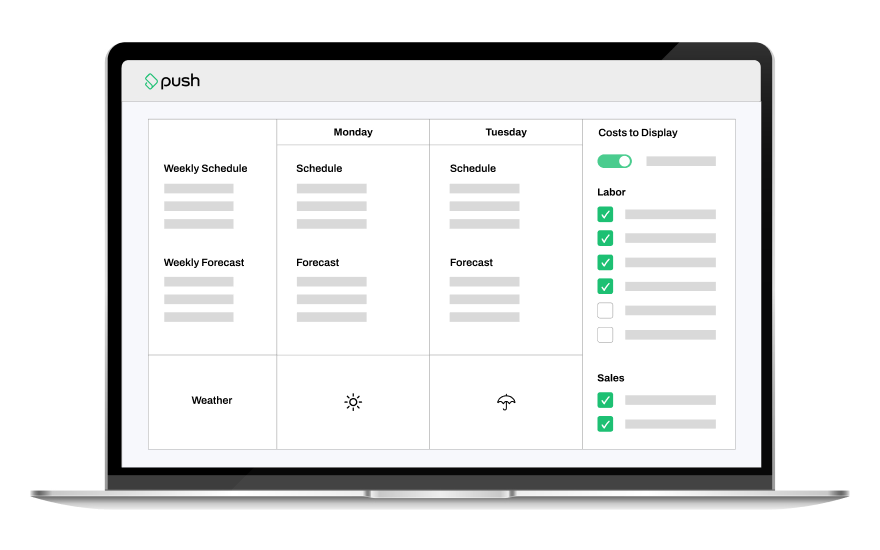
A labor-to-sales target discovered after payroll runs is a report card. The same target visible while a manager is dragging shifts around is a decision tool. Push Scheduling pulls POS sales data directly into the schedule builder, so the labor percentage moves in real time as shifts are added — the manager sees the cost of the tenth server before publishing, not eleven days later.
3. Give the Number an Owner
This is the piece most operators skip. Red Robin pairs its tools with a managing partner program that gives operators profit share against their own restaurant's performance. Pace credited "the accountability and ownership embedded in our managing partner model, which rewards our partners directly for the improvements they drive in their own restaurants."
Tools don't move a P&L on their own. A manager who sees the labor number and has no stake in it will treat it as one more thing corporate is measuring. A manager with something riding on it will find the fifty basis points themselves.
Scale is no barrier to this working. Push runs workforce management across Crumbl's 1,000+ North American locations, and as Crumbl CEO Jason McGowan put it, the point is giving franchise owners the option "to manage labor costs and process payroll in minutes rather than hours." The mechanics that free up a single manager's Tuesday afternoon are the same ones that hold a thousand schedules to a standard.
The Money Was Already in the Schedule
Fifty basis points isn't a headline number. That's exactly why it's worth paying attention to — it didn't come from a new daypart, a new market, or a menu overhaul. It came from a chain admitting it had been staffing to habit rather than to demand, and then fixing the arithmetic.
Most operators are sitting on some version of the same gap. It's spread thin across a hundred shifts, which is precisely why it's easy to miss and hard to argue with once you see it. And finding it isn't a referendum on how well you've been running your restaurants — schedules drift for the same reason anything does, because the person building them is doing it at 11 p.m. between a delivery problem and a callout.
If you'd like to see what your own schedule is hiding, book a demo — we'll pull up your labor curve against your sales curve and walk through where the daylight is.